
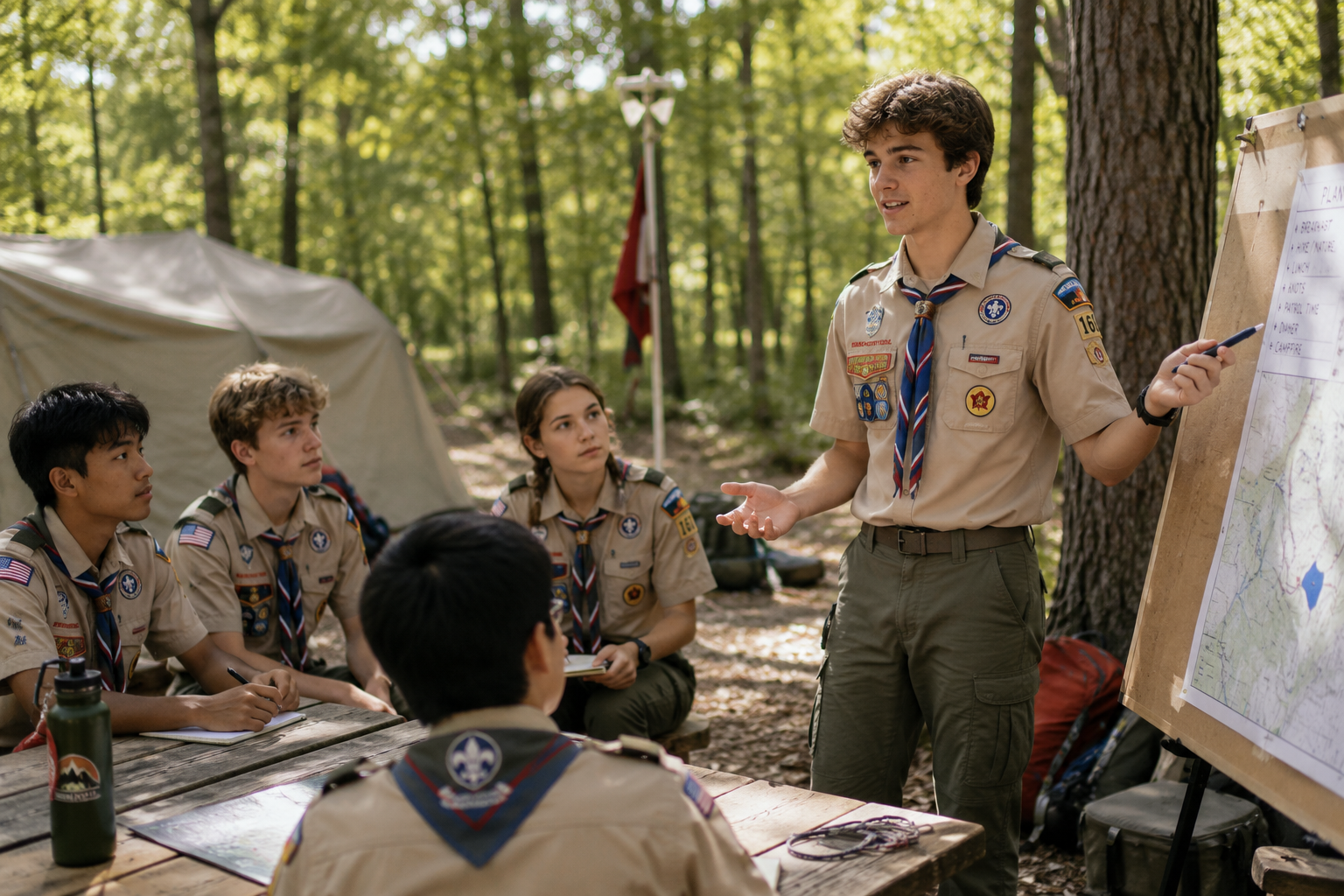
National Youth Leadership Training (NYLT) is a crucial step in preparing scouts for the demands of the highest youth role in a troop. While introductory training provides a solid baseline, making NYLT a prerequisite for senior patrol leader helps ensure candidates have the hands-on practice, maturity, and confidence needed to effectively guide a youth-led troop.
The senior patrol leader is arguably the most important youth leadership position in any scout troop. They are expected to lead meetings, guide the patrol leaders’ council, communicate bridging plans with adults, and help carry out the troop’s entire annual program.
Scouting America allows each individual troop to establish its own eligibility requirements for youth leadership positions through unit bylaws or committee-approved procedures. Because the SPL role carries so much weight, many units establish stricter qualifications for candidates than the standard minimums. Common troop requirements often include holding a minimum rank of First Class or Star, being at least 14 years old, and serving successfully in previous leadership positions.
These requirements exist because leading an entire troop requires significantly more maturity, experience, and preparation than many other youth roles. Too often, however, scouts are elected without receiving meaningful leadership training first. A younger scout who only recently became eligible may be well-liked and highly enthusiastic, but that does not always mean they are ready to handle the complex dynamics of leading their peers.
Introduction to Leadership Skills for Troops (ILS-T) provides an important starting point, but introductory troop-level instruction alone may not adequately prepare a scout for the high demands of serving as an SPL. That is why National Youth Leadership Training gives scouts an extended, hands-on environment in which to practice leadership before taking responsibility for their home troop.
Key takeaways
Implementing a formal training requirement can fundamentally shift how your troop operates and how your youth leaders perform. Here is a quick look at why this prerequisite makes a difference:
- The senior patrol leader role requires advanced problem-solving, delegation, and communication skills that go beyond basic rank requirements.
- Requiring advanced training helps ensure troop elections remain focused on leadership readiness rather than simply rewarding popularity.
- ILS-T introduces troop-specific roles, but NYLT provides the immersive, hands-on practice required to master team development.
- Troops must actively support this prerequisite by helping scouts with scheduling, logistics, and financial assistance to attend the course.
Table of Contents
The SPL position carries significant responsibility
The senior patrol leader is not simply the scout who stands at the front of the room or the one who wins the most votes on election night. The SPL helps orchestrate troop meetings, campouts, ceremonies, community activities, and the patrol leaders’ council.
This position requires high-level communication, organization, delegation, problem-solving, and conflict-management skills. A scout may meet the minimum age or rank requirements on paper and still need significantly more hands-on experience before being ready to serve successfully in the top spot.
Most successful troops recognize this reality by establishing clear prerequisites, such as prior leadership experience or training expectations. Placing an unprepared scout in the SPL role can create intense frustration for the scout, the troop, the other youth leaders, and the adult volunteers trying to support them.
Being eligible to serve does not automatically mean a scout is prepared to serve successfully. Here are the core responsibilities an SPL must be prepared to handle:
-
Lead troop meetings and other troop gatherings effectively.
-
Chair the patrol leaders’ council to plan upcoming events.
-
Communicate plans clearly to patrol leaders and other youth leaders.
-
Delegate responsibilities instead of trying to do everything alone.
-
Work closely with the scoutmaster while maintaining youth ownership of the program.
-
Respond calmly when plans change unexpectedly or interpersonal conflicts develop.
-
Set a strong example through reliability, preparation, and scout-like conduct.
Elections should identify a leader, not reward popularity

Youth elections are an integral part of a healthy, youth-led troop, giving scouts a vital voice in their program. However, these elections can quickly turn into popularity contests if the troop does not establish clear standards for its candidates.
Scouts may naturally vote for a close friend, the funniest candidate, the most outgoing scout, or the person who makes the biggest promises. While those qualities may help a candidate receive votes, they do not necessarily demonstrate a readiness to organize meetings, guide other youth, resolve disagreements, or follow through on complex responsibilities.
A younger scout who barely meets the minimum requirements may have incredible potential, but potential and readiness are not always the same thing. Requiring a NYLT prerequisite for senior patrol leader creates a meaningful qualification beyond simply reaching a minimum age or earning a specific rank.
This requirement helps guarantee that every candidate has invested genuine time in learning and practicing leadership before asking the troop to elect them.
| What May Win Votes | What the SPL Position Actually Requires |
|---|---|
| Being funny or entertaining | Keeping meetings organized and productive |
| Having many friends | Treating all Scouts and patrols fairly |
| Making exciting campaign promises | Turning ideas into realistic, actionable plans |
| Being highly outgoing | Listening actively and communicating clearly |
| Recently meeting minimum qualifications | Demonstrating consistent maturity and preparation |
| Being well-liked by peers | Following through when leadership becomes difficult |
Introduction to Leadership Skills for Troops is important—but not enough for an SPL
Introduction to Leadership Skills for Troops, commonly called ILS-T, remains an incredibly important part of the youth-leader training journey. It helps newly elected or appointed youth leaders understand their specific positions, their daily responsibilities, and their place within the troop’s organizational structure.
Every troop should conduct ILS-T regularly, and every youth leader should participate to build a shared baseline of knowledge. However, its core purpose is purely introductory. It provides a foundational framework rather than the complete, rigorous leadership-development experience an SPL usually needs.
ILS-T is typically conducted within the scout’s own troop by the scoutmaster, current SPL, or other familiar troop leaders. The experience can vary considerably from troop to troop depending on how much time is devoted to it, how closely the syllabus is followed, and how much instructional experience the adults possess.
Even when ILS-T is conducted perfectly, scouts are still learning beside their familiar friends within their normal, comfortable troop environment. That deep familiarity can make it harder for scouts to step outside their usual roles, practice entirely unfamiliar leadership techniques, or receive truly objective feedback from their peers. Explanation alone is not the same as repeatedly practicing leadership under realistic, challenging conditions.
NYLT goes beyond an introduction

NYLT builds upon the critical foundation provided by ILS-T rather than attempting to replace it. It gives participants an extended, immersive leadership experience instead of a brief troop-level orientation.
Scouts spend several days living and working as members of a brand-new team, applying advanced leadership skills throughout the entire course. Participants do more than just listen to presentations about communication, goal-setting, delegation, and problem-solving—they actively practice those skills in real time.
During the course, scouts experience the different stages of team development firsthand. They see exactly how a leader’s approach may need to adapt and change as a team grows from a group of strangers into a high-performing patrol.
Because participants must work with scouts they may not already know, they cannot rely on existing friendships or their established reputation within their home troop. This dynamic places all scouts on more equal footing and forces them to lead through their daily actions instead of relying on their popularity.
NYLT leadership skills are developed through a clear, structured process:
- The scout joins a newly formed team made up of youth from outside their home troop.
- The scout observes highly trained youth staff modeling effective leadership techniques.
- The scout learns specific communication, planning, and team-building methods.
- The scout applies those exact methods during high-energy activities and leadership challenges.
- The scout receives objective, constructive feedback from their peers and course staff.
- The scout adjusts their approach, tries again, and slowly becomes more confident.
- The scout returns home armed with practical ideas and the motivation to strengthen their own troop.
ILS-T and NYLT should work together
The argument for making NYLT a prerequisite should never be interpreted as a criticism of ILS-T. The two training courses serve entirely different, but highly complementary, purposes in a scout's development.
ILS-T helps scouts understand their specific troop positions and the mechanics of how their home troop’s youth-leadership structure operates on a weekly basis. It answers the immediate question: “What is my position, and what exactly am I expected to do?”
Conversely, NYLT develops broader, life-long leadership skills through an immersive experience outside the comfort zone of the home troop. It tackles the much larger, more complex question: “How do I effectively lead myself, build a cohesive team, and motivate other scouts?”
Treating ILS-T as a complete replacement for senior patrol leader training overlooks the intentional, designed progression from introductory orientation to advanced, practical application.
| Area | ILS-T | NYLT |
|---|---|---|
| Primary purpose | Introduces troop leadership positions and responsibilities | Develops and practices broader leadership skills |
| Setting | Conducted exclusively within the home troop | Conducted with Scouts from multiple different units |
| Experience | Introductory and heavily troop-specific | Extended, immersive, and heavily application-focused |
| Instructors | Home troop leaders and experienced older youth | Highly trained youth staff with careful adult guidance |
| Familiarity | Scouts usually train alongside people they already know | Scouts must adapt to working with brand-new people |
| Leadership practice | Depends heavily on how the troop presents the course | Leadership is practiced continuously throughout the experience |
| Main question answered | “What is my job?” | “How do I lead effectively?” |
| Best use | Training all newly appointed or elected youth leaders | Preparing older Scouts for major troop leadership responsibilities |
A healthy troop will establish a clear, structured pipeline for its future leaders. A recommended leadership pathway might look like this:
- Participate actively as a patrol member to understand team dynamics.
- Serve successfully in an introductory troop leadership position, such as quartermaster or scribe.
- Complete ILS-T with the home troop.
- Practice basic leadership within the patrol and troop environment.
- Attend NYLT to gain advanced skills and confidence.
- Serve in progressively responsible youth positions, such as patrol leader or troop guide.
- Meet the troop’s specific SPL eligibility requirements, checking off rank, age, and training prerequisites.
- Become eligible to formally run for senior patrol leader.
- Receive continued coaching and mentoring from the scoutmaster after being elected.
The requirement should be supported by the troop

Troops should never create a stringent requirement without also providing the necessary support to help scouts meet it. Because you are establishing your own unit's eligibility standards, any NYLT prerequisite must be clearly documented in your troop bylaws, leadership policies, or committee-approved procedures so families are not caught off guard.
The scoutmaster, assistant scoutmasters, and troop committee must work collaboratively to identify younger scouts who show early leadership potential. These potential future leaders should be warmly encouraged to attend training long before they actually become eligible to run for the top spot.
The troop should actively promote this training as a core part of its leadership-development pathway rather than passively waiting for scouts to discover the opportunity on their own. Whenever possible, the troop committee should assist families with registration logistics, transportation carpools, and schedule planning.
Financial support is also critical. A troop should strongly consider providing financial assistance so that course costs do not become an artificial barrier to a scout's leadership development. Some well-funded troops may be able to pay the full cost for selected youth, while others should aim to cover at least half of the registration fee through troop funds, dedicated fundraising efforts, or local campership programs.
If a troop is implementing this rule for the first time, a reasonable transition period is usually necessary. Small troops, or units that have not previously sent youth to advanced training, will need time to build up a pipeline of qualified candidates. In these transitional situations, the scoutmaster may need to temporarily waive the requirement rather than leaving the vital SPL position vacant.
Any waiver should be treated strictly as a practical exception, not a reason to abandon the overarching goal. The troop should then create a solid, actionable plan to send future candidates to training so the prerequisite can be fully enforced in future election cycles.
Building a troop culture where leadership preparation matters

Scouting gives individual troops the distinct authority to establish eligibility requirements for their youth leadership positions, and it is entirely reasonable to set a high bar for the senior patrol leader. The role is simply too demanding, and too important to the health of a youth-led troop, to treat brief, introductory instruction as complete preparation.
While ILS-T gives scouts a necessary, foundational understanding of their weekly roles, NYLT builds upon that foundation through deep immersion, dynamic teamwork, repeated practice, and peer feedback. It inspires scouts with a renewed enthusiasm for service—enthusiasm that almost always transfers directly back to their home patrols.
An election should serve to identify a prepared, capable leader, not just crown the most popular candidate in the room. Requiring advanced training ensures that candidates have progressed well beyond a basic introduction and have spent meaningful, challenging time learning how to actually guide others.
If a troop is willing to require specific ranks, minimum ages, and prior leadership experience before a scout can run for office, they should firmly consider requiring advanced leadership training as well. Require the training, actively support your scouts in completing it, allow for reasonable exceptions during transition periods, and build a troop culture where deep leadership preparation matters just as much as winning the election.
When your youth leaders are truly prepared, the entire troop benefits from a smoother, more engaging, and more successful scouting program. How will your troop adjust its bylaws this season to ensure your next senior patrol leader is set up for success?
Frequently Asked Questions About NYLT Prerequisites for Senior Patrol Leaders
What if our troop is too small to require NYLT for the senior patrol leader?
Does NYLT replace the need for troop-level training?
How can we help families afford the cost of NYLT?
What age is best for a Scout to attend NYLT?
Can we waive the NYLT requirement if a highly qualified Scout has not attended?
Content Disclaimer – SmartScouter.org is an independent blog created to share practical tips, ideas, commentary, experiences, and resources for Scouts, leaders, parents, volunteers, and others interested in supporting youth-led Scouting programs. The information published on this website is intended for general informational and educational purposes and should not be considered official Scouting guidance.
SmartScouter is not affiliated with, endorsed by, sponsored by, or operated by Scouting America, any local council, district, lodge, troop, pack, crew, ship, chartered organization, or any other Scouting entity. This website is maintained independently, and the opinions, recommendations, interpretations, and viewpoints expressed are those of the author or contributor and do not necessarily reflect the official positions, policies, or guidance of Scouting America or any other Scouting organization.
While we strive to provide accurate, helpful, and up-to-date information, Scouting policies, procedures, requirements, and program guidance may change over time. SmartScouter does not guarantee that all content is complete, current, accurate, or applicable to every Scouting unit, council, district, lodge, chartered organization, or individual situation.
Most images on SmartScouter.org are created or edited using AI. Because of this, certain details may occasionally appear unusual, inaccurate, or slightly unrealistic, including uniforms, insignia, and patch placement. These images are intended to illustrate the topic and do not represent actual Scouting events unless otherwise stated.
For official policies, procedures, requirements, safety standards, advancement guidance, Youth Protection policies, training materials, and program information, readers should always consult the most current Scouting America publications, handbooks, official websites, and documentation. When questions arise regarding the interpretation or implementation of official Scouting policies, readers should seek guidance from official Scouting America resources and their local council, district, or unit leadership.